UX Strategy x Product Design
How do you compete in streaming without subscriptions or originals?
By offering a unique value proposition through a connected entertainment ecosystem. In this case, by turning three disconnected platforms: Fandango (Ticketing), Fandango at Home (Streaming) and Rotten Tomatoes (Reviews & Rating), into one ecosystem that extends the movie experience before, during, and after viewing.
Timeline
January 2026 - June 2026
ROLE
UX Strategy · Ticketing integration · Ad XD
TEAM
4 multidisciplinary student team
01
Context
Turn a transactional movie store into an ad-supported streaming platform.
We were asked to reimagine Fandango’s new platform called "At Home", transition from a transactional movie platform into an ad-supported streaming platform. Our challenge was to define what could make Fandango at Home uniquely valuable under AVOD (Ad-Supported Video on Demand) constraints, while retaining legacy digital collectors and attracting a new generation of streaming-first users.
Three hard constraints.
CONSTRAINT 01
Focus on AVOD
Ads are the business model. Ad experience needs to be optimized for watch time and conversion.
CONSTRAINT 02
NO SUBSCRIPTIONS
Monetization through subscriptions was explicitly off the table.
CONSTRAINT 03
NO ORIGINALS
The company cannot produce original content.
EVERYONE KNEW FANDANGO.
EVERYONE KNEW ROTTEN TOMATOES.
almost nobody knew FANDANGO AT HOME.
Worse: nobody knew the three platforms belonged to the same parent, Versant. It became apparent that the company didn't have a content problem, they had a handoff problem.
02
Findings
USERS WANT ADS last.
THE BUSINESS NEEDS THEM first.
Users preferred ads in the final 30% of a film to preserve emotional continuity, while the business needed ads within the first 70% to maximize retention and monetization before viewers dropped off. Retention and revenue both bias toward earlier breaks
Ads in last 30%
Ads in first 70%
WHAT USERS WANT
WHAT BUSINESS NEEDS
00%
25%
50%
75%
100%
Tune how ads interrupt youYou can change them later.
WHEN
RHYTHM
2 breaks · ~30s each
Your Episode will look like
STARTEND
Control
Predictability
30-sec cap
Content window offers users some control over their ad-experience. Users feel agency without spending decision budget.
A subtle 3–5s countdown surfaces just before a break. The interruption stops being a surprise, the cognitive cost drops.
The maximum unskippable ad-length is set to 30 seconds by default to reduce user drop off and frustration.



Ratings & Reviews
Ticketing
Streaming
Decide
Attend
Re-Watch
No other business owns all three aspects of the entertainment ecosystem.
03
Strategy
Given the new insight, we decided to pivot.
The brief now was to design an interconnected entertainment ecosystem.
With the why settled, we locked the who, what, and how.

The hook is "keep users inside the ecosystem". Each platform plays a different role in the same loop.
Audience
18–34
Streaming‑first viewers.
Surfaces
TV · LAPTOP
Mobile as a strategic extension.
Content Focus
FRANCHISES
Invite continuation & cross‑platform return.
ENTRY
ENGAGEMENT
Conversion
Conversion feeds Re-entry
Entertainment ecosystem engine
A Rotten Tomatoes score, a Fandango ticket, a FaH film tile, each is a way in.
Predictable ads, social signal, mood-aware discovery, unique features that make users stay.
Watch, buy, save, share, rate, the action doesn't have to be a purchase.
05
Final Design


The user lands on Rotten Tomatoes to verify. The score answers "is it good?"
The bridge appears as the intent peaks.

Rotten tomatoes spotlights the platforms in the Ecosystem
Rotten Tomatoes
Get Tickets
Watch Free
Release Window
Fandango
Fandango At Home


Rewards are teased before checkout so that the promise forms while the user is still choosing.
The unlock list sits between the total and the CTA to raise the perceived value.
Before
After
The design calls out the platforms owned by versant more prominently to tap into the ecosystem.
Raise perceived value of conversion while buying tickets.
If: In Theaters
If: Streaming
FANREWARDS UNLOCKS
Cast Interviews
48h Access · 1 Ad-Free Movie
Friend Pass
Sneak Peek
+125 PTS UNLOCKED
Confirm Purchase
Name rewards that a fan can picture
Value is stated at the exact moment the user weighs the ticket price against walking away.

Rewards are accessible at Fandango at Home , making this the next product's front door too.
FANDANGO AT HOME TURNS THE WAIT INTO A RITUAL


When users arrive on "At Home", the platform already knows what they bought and when it's showing, and has built them a playlist of related titles along with their rewards before they even ask.
This is where users find part of their unlocked rewards, alongside content matched to their screening and taste. The playlist does three things: reinforces the ecosystem, reduces decision time, and gives users an immediate reason to engage with the platform.
TICKET CONFIRMED
Sinners · IMAX
Sat, 7:00 PM
AMC Pacific Place
+250 PTS EARNED
Open at Home →
PREPARE FOR YOUR SCREENING
Sinners
4DAYS
14HOURS
22MIN
Start your Ritual →
YOUR PRE-MOVIE PLAYLIST
Director interview · 12 min
Related film · 48h free
Critics' picks
Score featurette
0/5 WATCHED · +25 PTS ON COMPLETE
The ticket is confirmed and the user is shown a CTA to access rewards on "At Home"
FAH already knows the user's show timings. it's the highest-anticipation window the platform will ever get with this user.
"Start your Ritual" replaces an open-ended catalog with a single, personal next step.
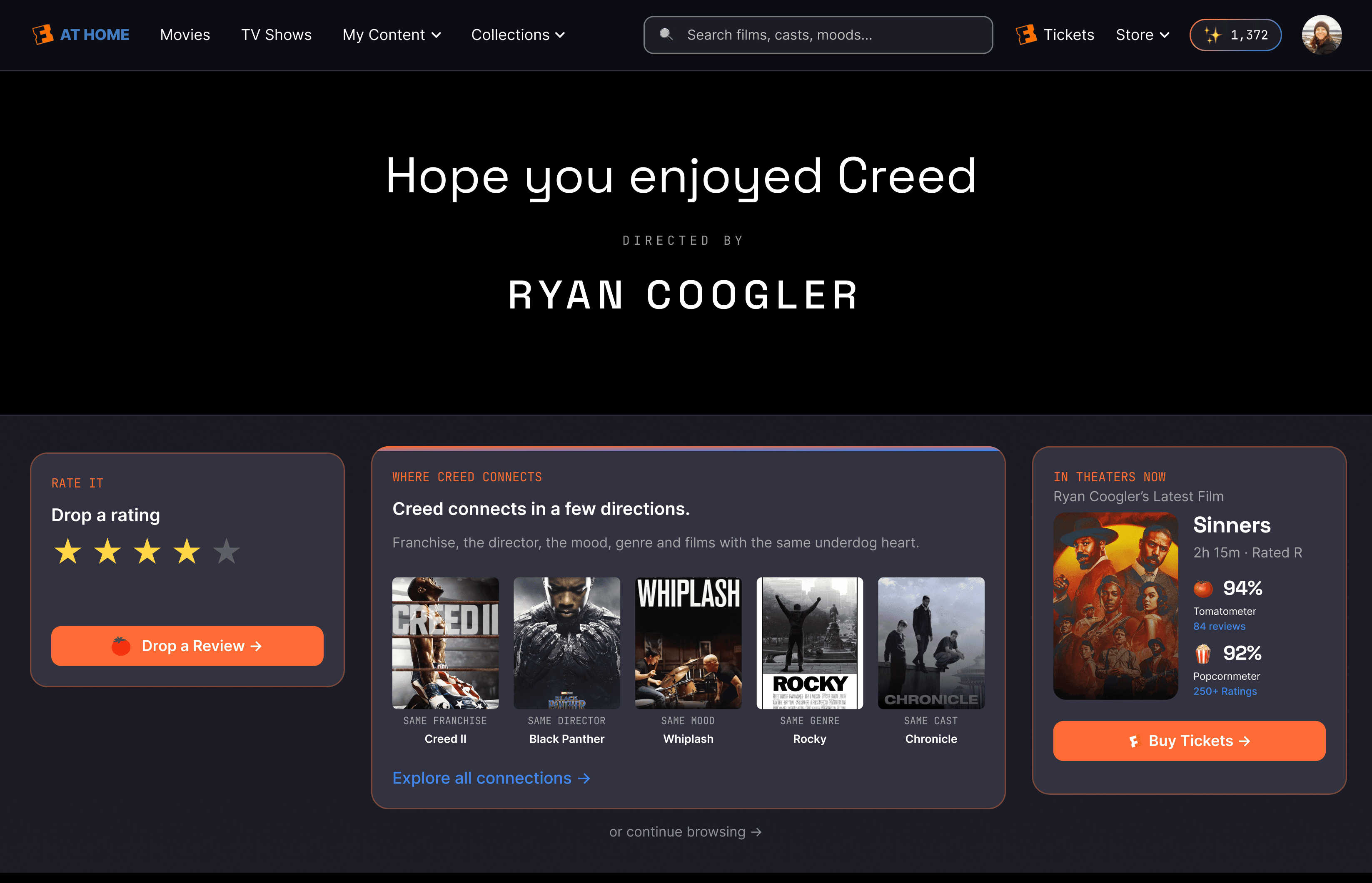
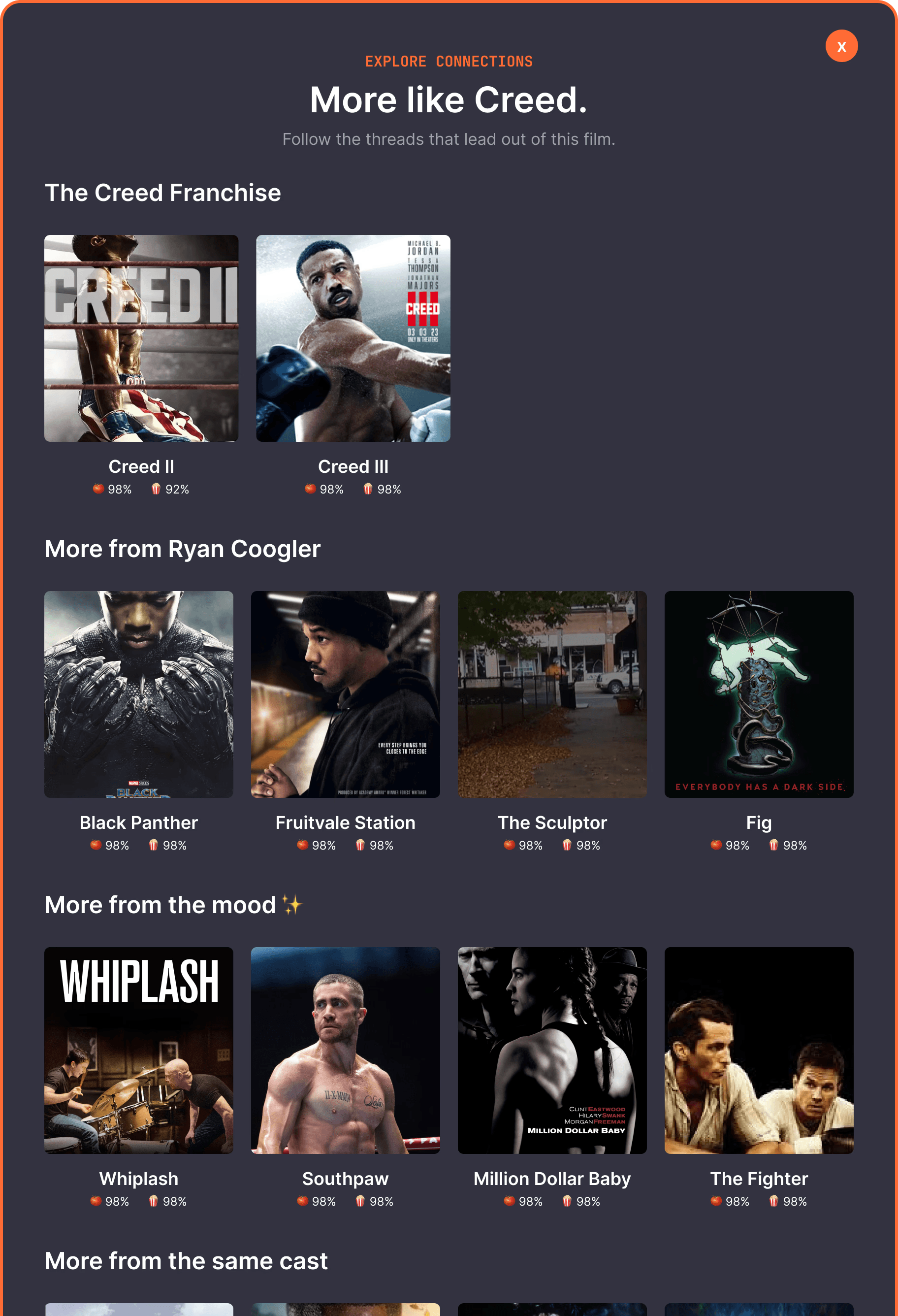
Utilizing end credits to connect the ecosystem and increase engagement

RATE IT
★★★★★
Drop a Review →
FEEDS ROTTEN TOMATOES
WHERE IT CONNECTS
FranchiseDirectorMoodGenreCast
EXPLORE ALL CONNECTIONS →
DEEPENS FANDANGO AT HOME
IN THEATERS NOW
Sinners
2h 15m · Rated R · 94% · 92%
Buy Tickets →
RETURNS TO FANDANGO
OPENNESS TO A NEXT STEP
BROWSE
DECIDING · GUARDED
WATCH
LOCKED IN · UNREACHABLE
CREDITS
SATISFIED · RECEPTIVE
EXIT
GONE

EVERY PLATFORM STAMPS THE SAME Passport
@S_Hearts_Movies
MEMBER SINCE MARCH 2024
● Silver Tier1,618 TO GOLD
1,372 PTS
AT HOME
23
FILMS
THEATERS
4
VISITS
REVIEWS
15
WRITTEN
TOTAL FILMS
27
HOME + THEATER
WATCH HOURS
48h
EST. TOTAL
Taste Profile
Sci-Fi
34
Drama
21
Thriller
18
Comedy
12
Climbing the ladder through engagement
Engagement across all 3 platforms tracked in the same place
A history of the user's engagement for movies and streaming
A dynamic taste profile that evolves with the user's engagement with the platforms
Value is stated at the exact moment the user weighs the ticket price against walking away.
Show users the actual awards that can be unlocked instead of just points
Incentive shown as soon as user comes to platform
Nav
Summary
PROBLEM
Fandango's new streaming platform called "At Home (FAH)" had almost 0 visibility among users, no distinct unique features and 3 hard constraints.
APPROACH
Reframed the brief from platform upgrade to a behavioral system that keeps users inside the ecosystem of products instead of leaving it.
MY CONTRIBUTION
Led UX strategy for the behavioral loop: Entry, Engagement, Conversion, Re-entry, and ad-experience design.
OUTCOME
5 High fidelity mockups for proposed high impact changes for ecosystem and the FAH platform. Got designs validated by senior stakeholders in Versant (Parent Company).
Hero Walkthrough video
© 2026 Saatvik Agrawal · HCDE '26 at UW · Seattle, WA
I hope you had a wonderful day.
I'm glad our paths crossed, hopefully my work left you with
a bit of curiosity and inspiration.