01
Context
For some riders, this app is the road home.
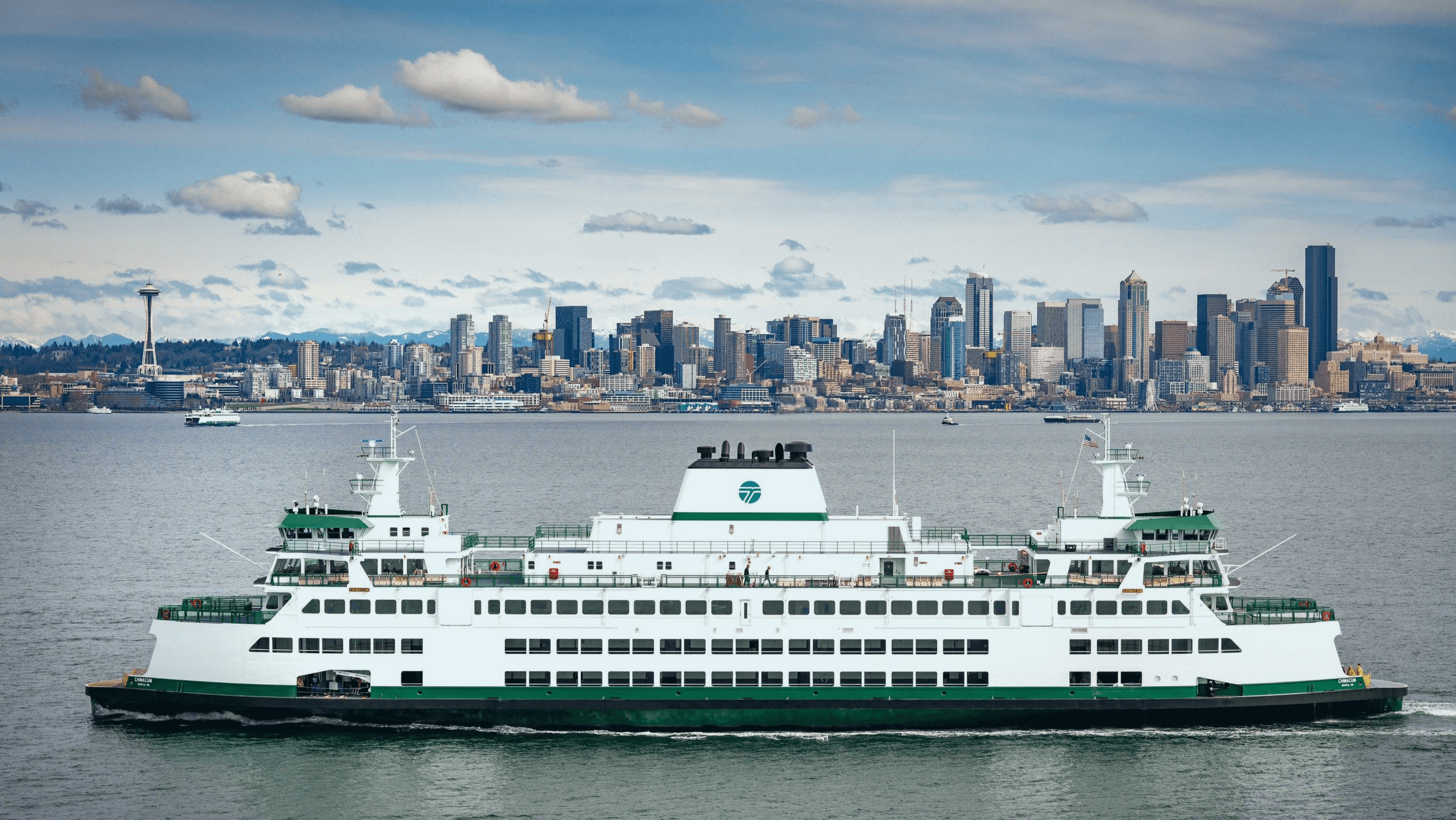
The WSDOT iOS app serves Washington State ferry riders navigating Puget Sound. We evaluated the Ferries section: Route Schedules, Vessel Watch, Buy Tickets, and Reservations, to find where friction lives between the app's structure and the decisions riders are actually trying to make.
Riders aren't a uniform group. Some are daily commuters; some visit once a year. For island residents, there is no alternative.
02
Method
Five steps from Exploration to intervention.
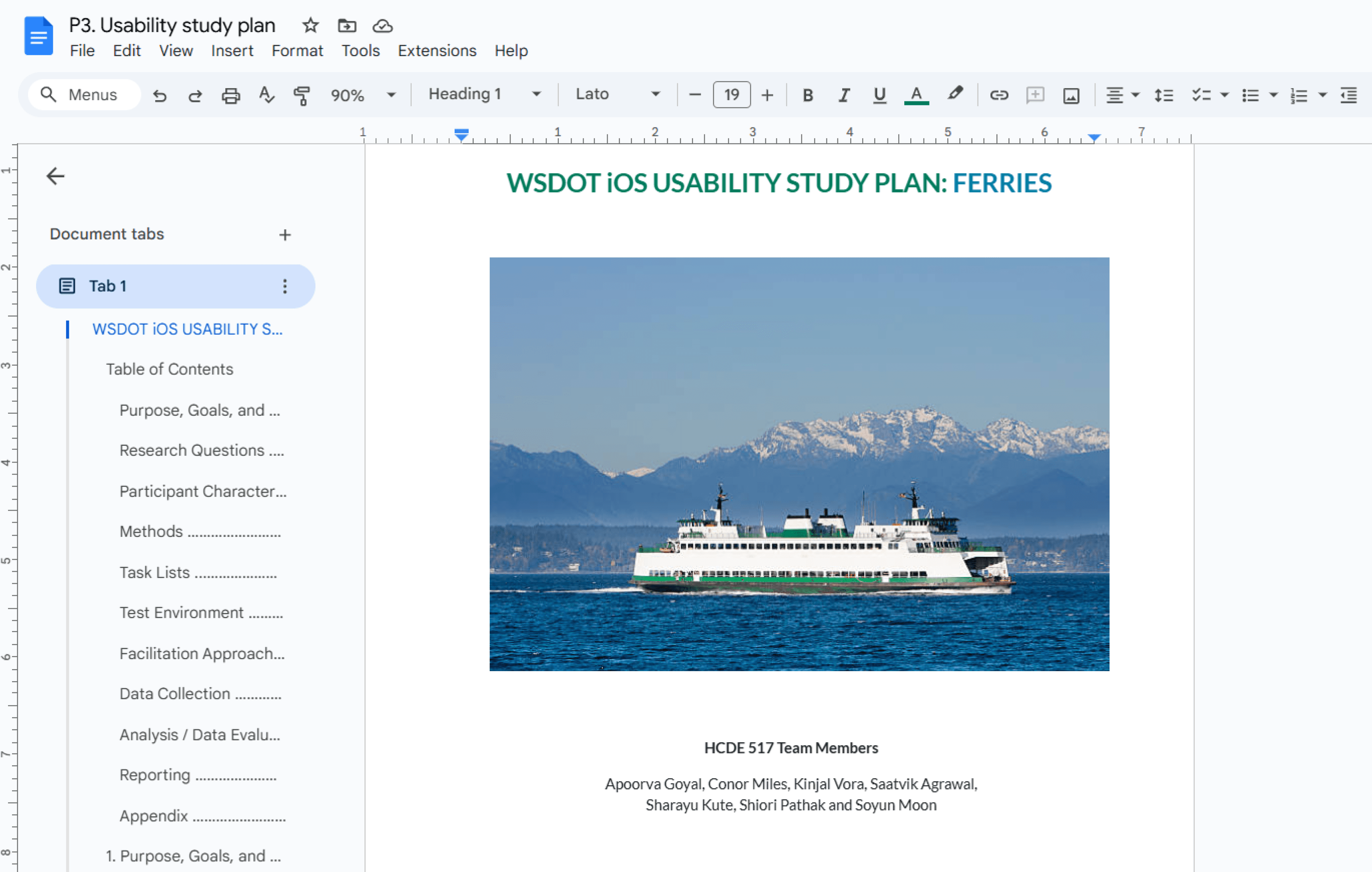
We didn't start by testing screens. We started by mapping every path the app makes possible — then designed tasks that put the most consequential paths under real use.

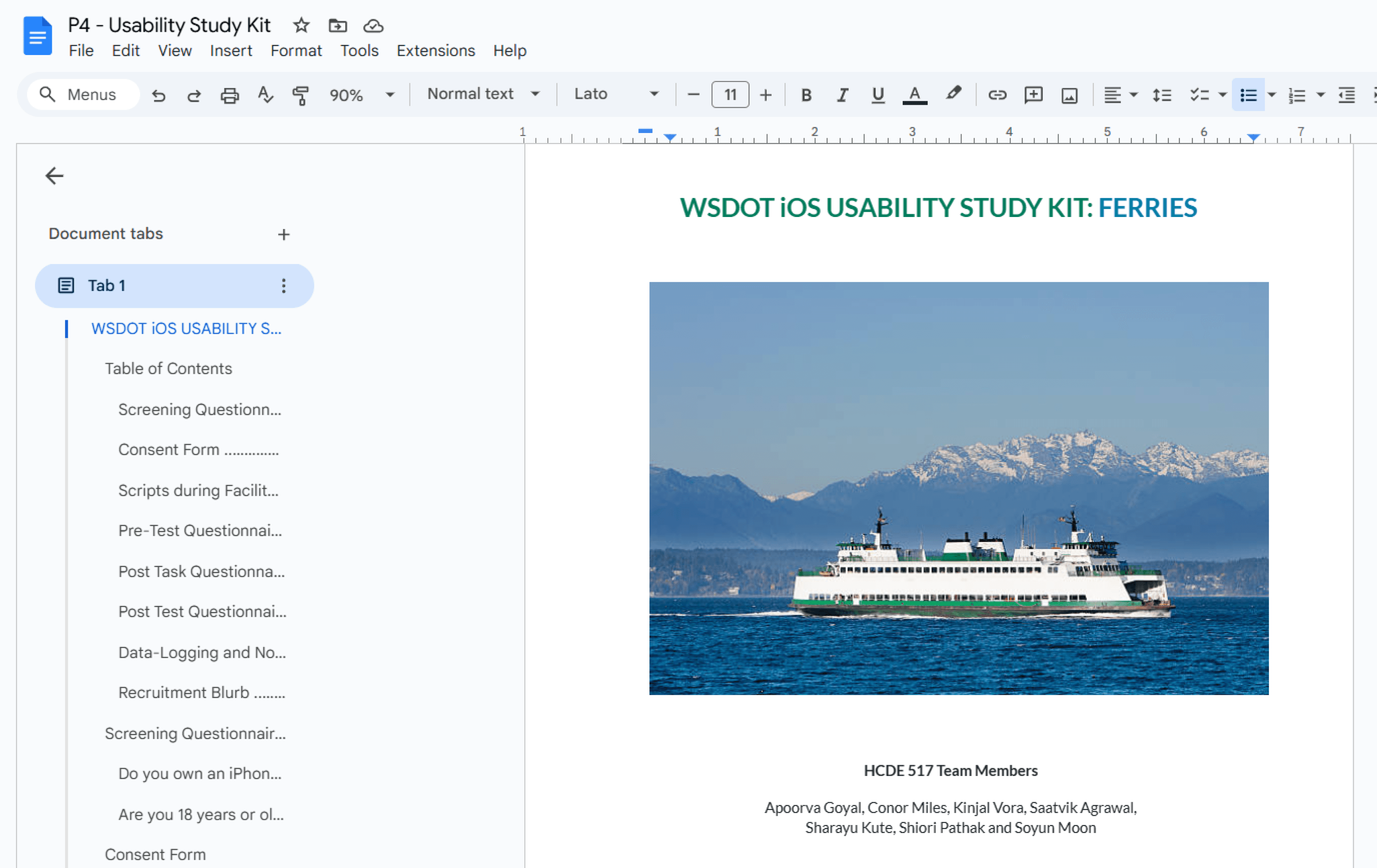
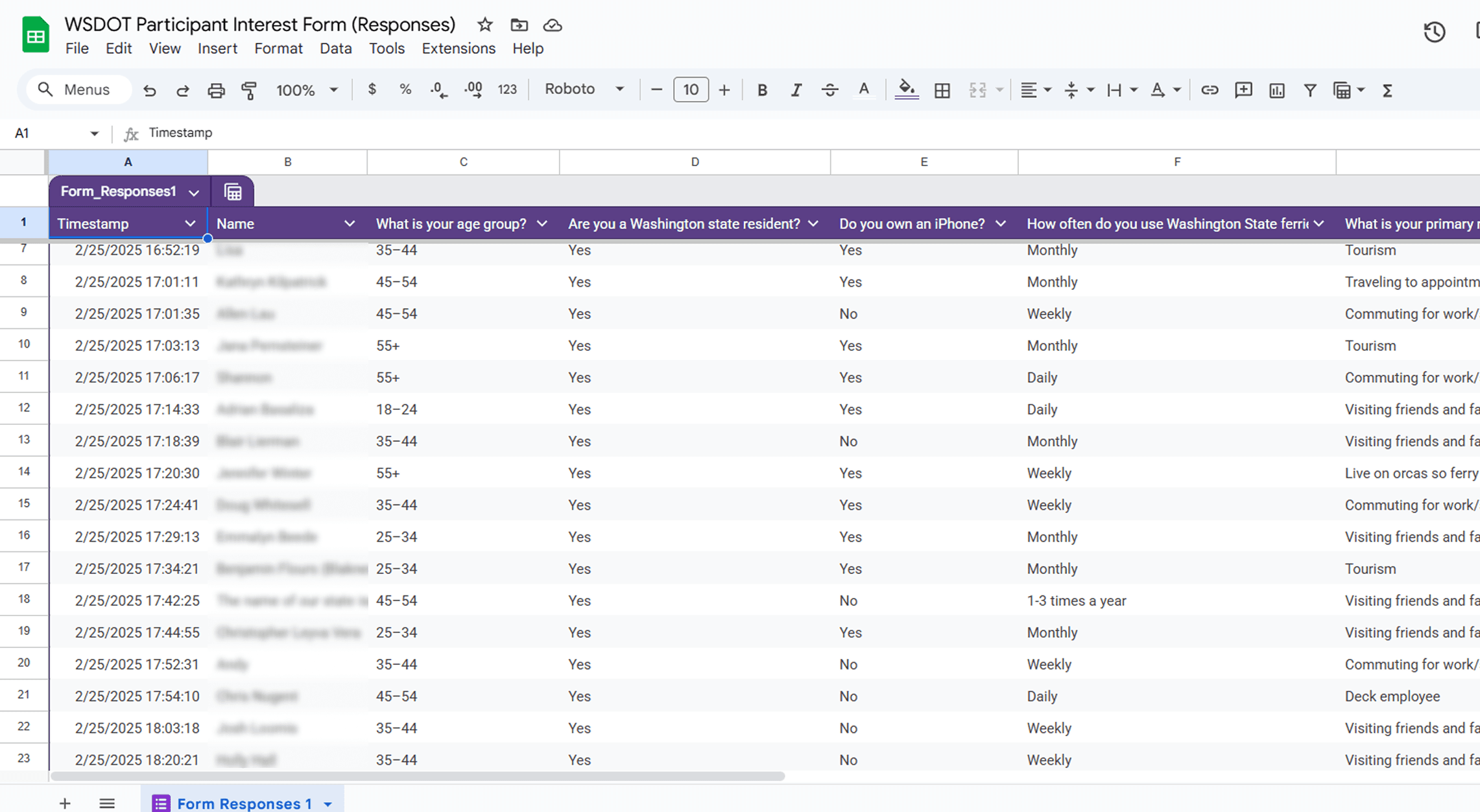
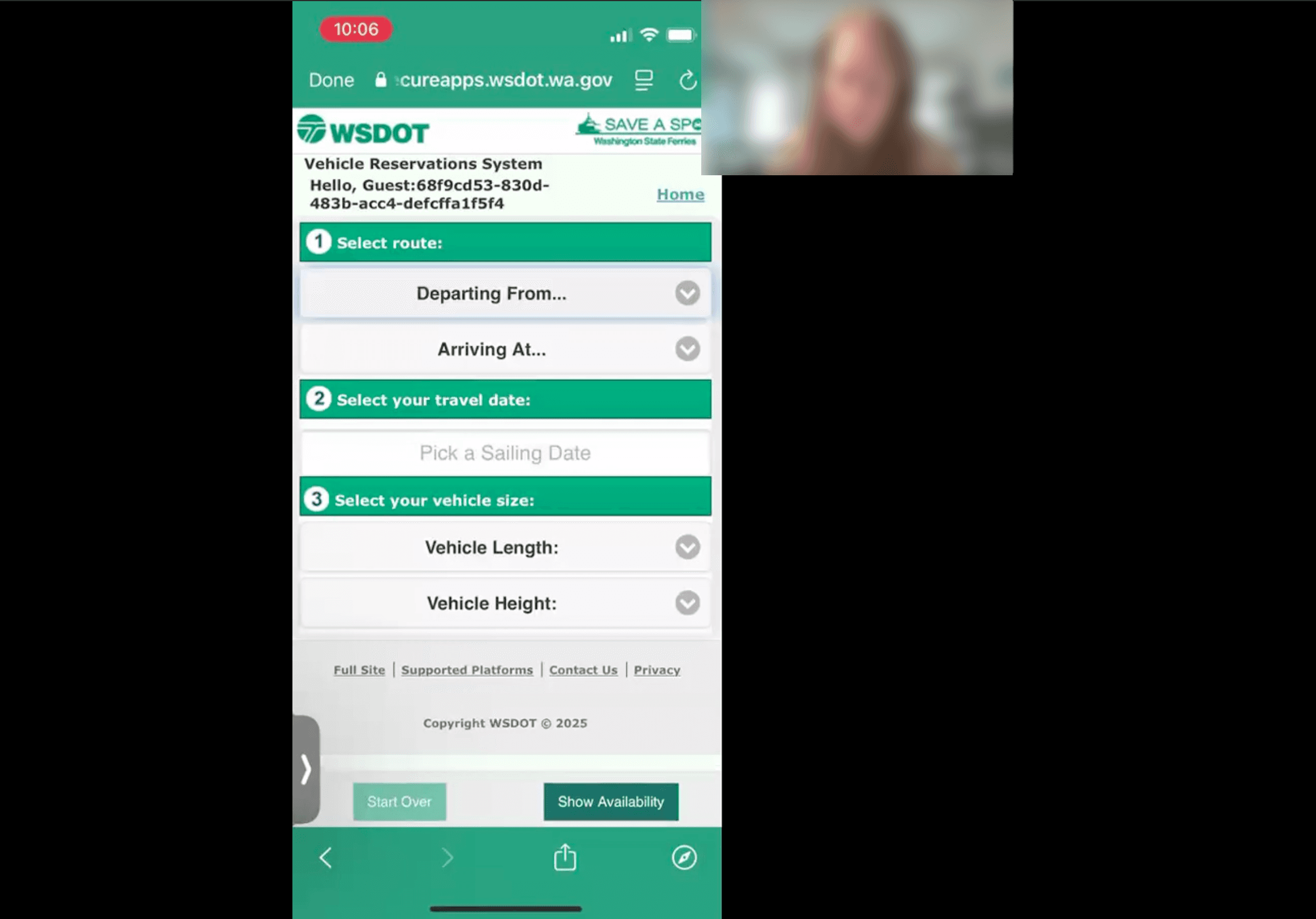
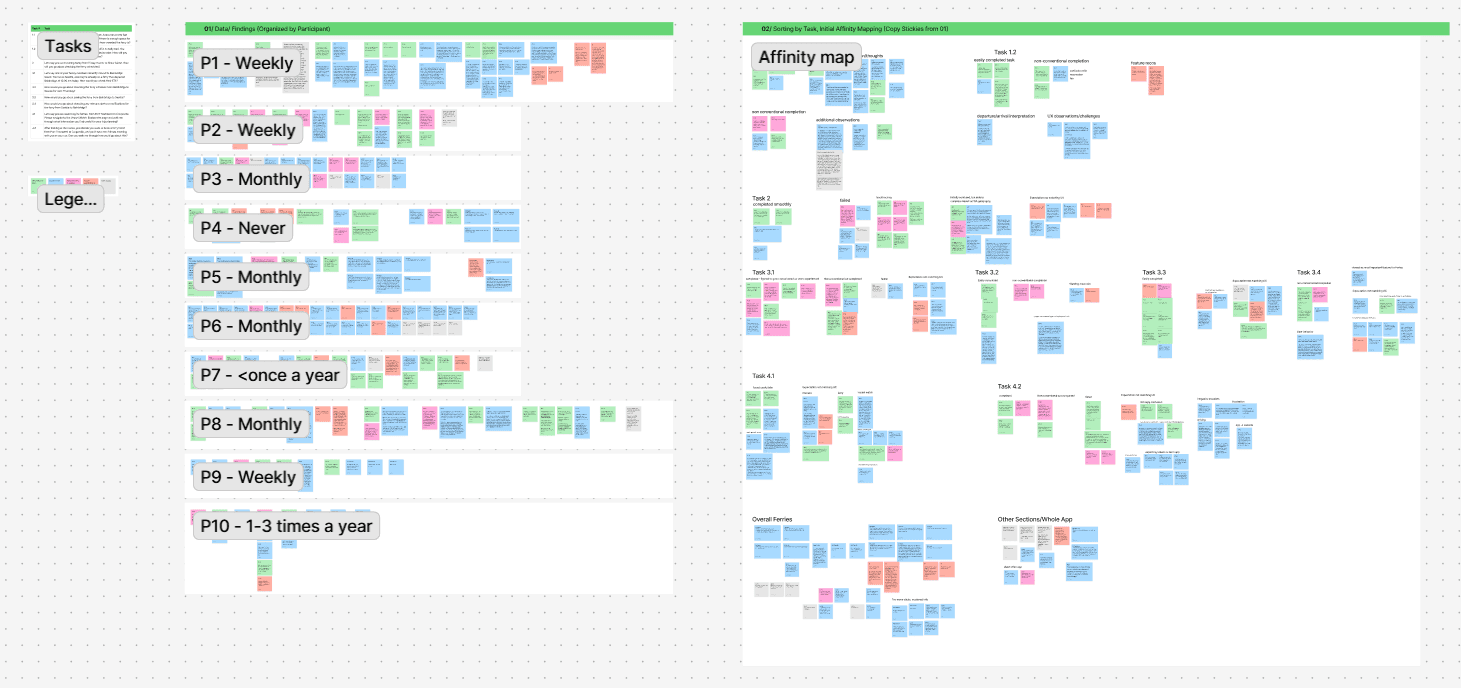
Click on images to access them, some can't be accessed to protect participant privacy
STEP 01
Map
Built a complete interaction map of the Ferries section — Route Schedules, Vessel Watch, Buy Tickets, Reservations.
STEP 02
Research Plan
9 task scenarios across 4 task groups: capacity, infrequent routes, ETA + alerts, ticketing.
STEP 03
Recruit
10 WA residents · iPhone owners · prior ferry-app experience. Daily commuters → annual tourists.
STEP 04
Moderate
Online sessions. Moderator + note-taker. Participants on personal iPhones + PC.
STEP 05
Synthesize
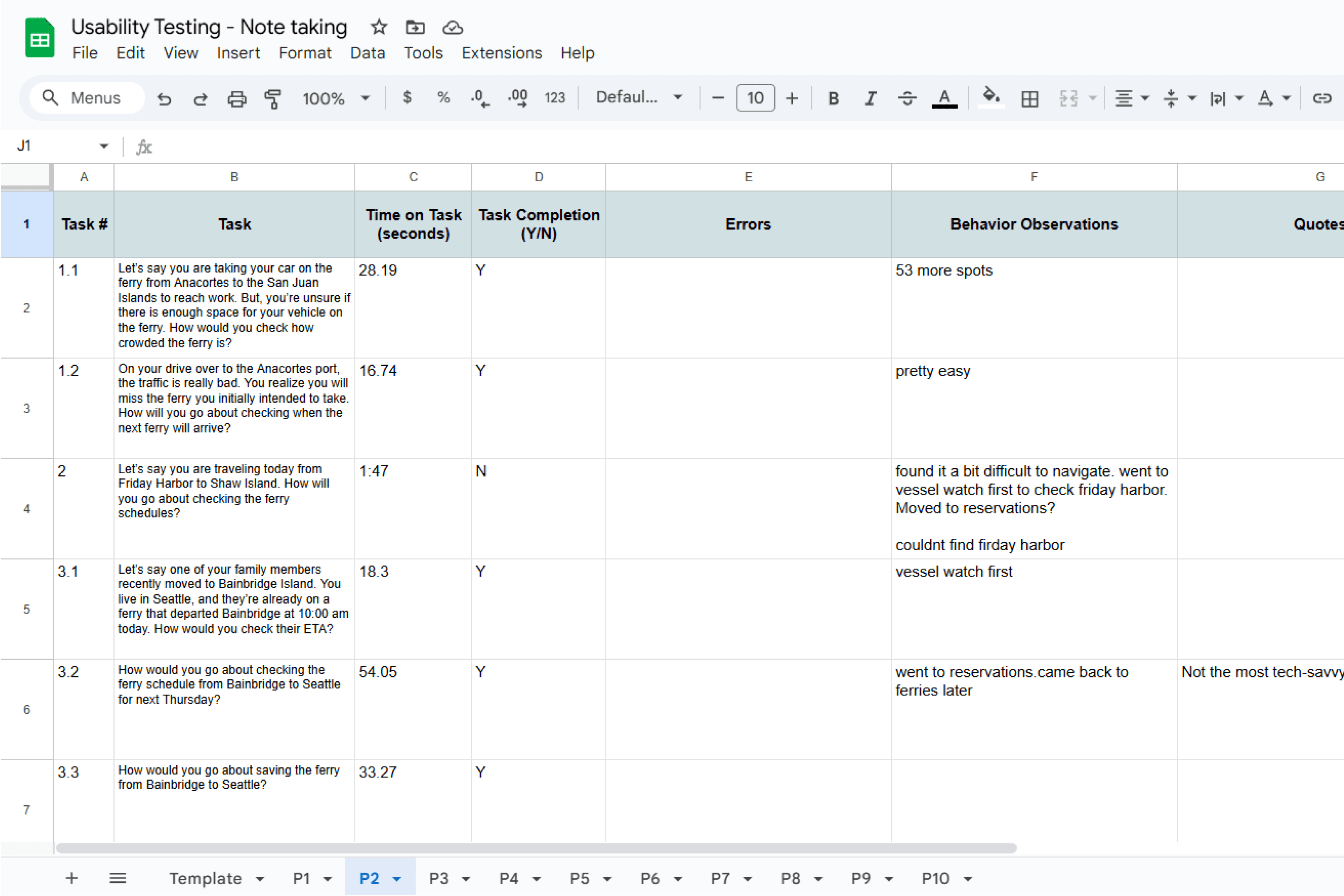
Notes → spreadsheet (time, completion, errors, quotes, paths) → affinity map by task.
Worked collaboratively for first 3 steps, moderated sessions with P9 and P10, took notes on the P4 session for step 4, and worked on the study plan and affinity-mapping synthesis with the team during step 5.
MY CONTRIBUTION
Nav
MY ROLE
Moderator · Notes · Affinity Synthesis
TEAM
4 HCDE 517 Researchers
SCOPE
10 sessions · 9 tasks · iOS
Usability Study x Redesign
The 26 moments where 2 million commutes fall apart every month.

By offering a unique value proposition through a connected entertainment ecosystem. In this case, by turning three disconnected platforms: Fandango (Ticketing), Fandango at Home (Streaming) and Rotten Tomatoes (Reviews & Rating), into one ecosystem that extends the movie experience before, during, and after viewing.
03
Findings
TASK RESULTS · 9 SCENARIOS
What happened when people actually used the app.
Completed
Mixed
Struggled
Times shown reflect P2's full session sheet; qualitative outcomes draw on affinity-map clusters across all 10 sessions.
TASK 1.1
COMPLETED
Capacity check
Anacortes → San Juan Islands. Is there space for the car?
Most completed. Capacity bar interpreted inconsistently.
28s
TASK 1.2
COMPLETED
Next departure
You're going to miss your ferry. When's the next one?
Quickly completed. "Pretty easy."
17s
TASK 2
STRUGGLED
Inter-island route
Friday Harbor → Shaw Island schedule.
Failures common. "Couldn't find Friday Harbor." Backtracking.
—
TASK 3.1
MIXED
In-progress ETA
Family on the Bainbridge ferry, when does it arrive?
Most went to Vessel Watch first. Some succeeded there, some had to backtrack.
18s
TASK 3.2
MIXED
Future schedule
Bainbridge → Seattle, one week from today.
Longest task. Users went to Reservations first by mistake.
54s
TASK 3.3
COMPLETED
Save route
Save Bainbridge → Seattle for quick access.
Largely completed. Save mechanism didn't match expectations.
33s
TASK 3.4
MIXED
Check alerts
Any alerts for Seattle → Bainbridge?
Expectation mismatch dominant. Users wanted alerts tied to saved routes.
—
TASK 4.1
MIXED
Explore Vessel Watch
Port Townsend → Coupeville. What helps trip planning?
Cameras and live tracking valued, but information felt scattered.
—
TASK 4.2
STRUGGLED
Buy a ticket
Tickets for you, two friends, and a car.
Most problematic task. External redirect; vehicle-size copy created anxiety.
—
Four patterns the sessions kept producing. (Out of 26)
Each finding is grounded in observed behavior, navigation paths, and quotes from the affinity map.
EVIDENCE
Task 4.2 was the most consistently problematic across participants. Failure clusters dominated: 'expecting tickets to be in app,' frustration, non-conventional completions, pricing confusion.
F · 01
HIGH SEVERITY
The ticket-buying flow breaks user expectations entirely.
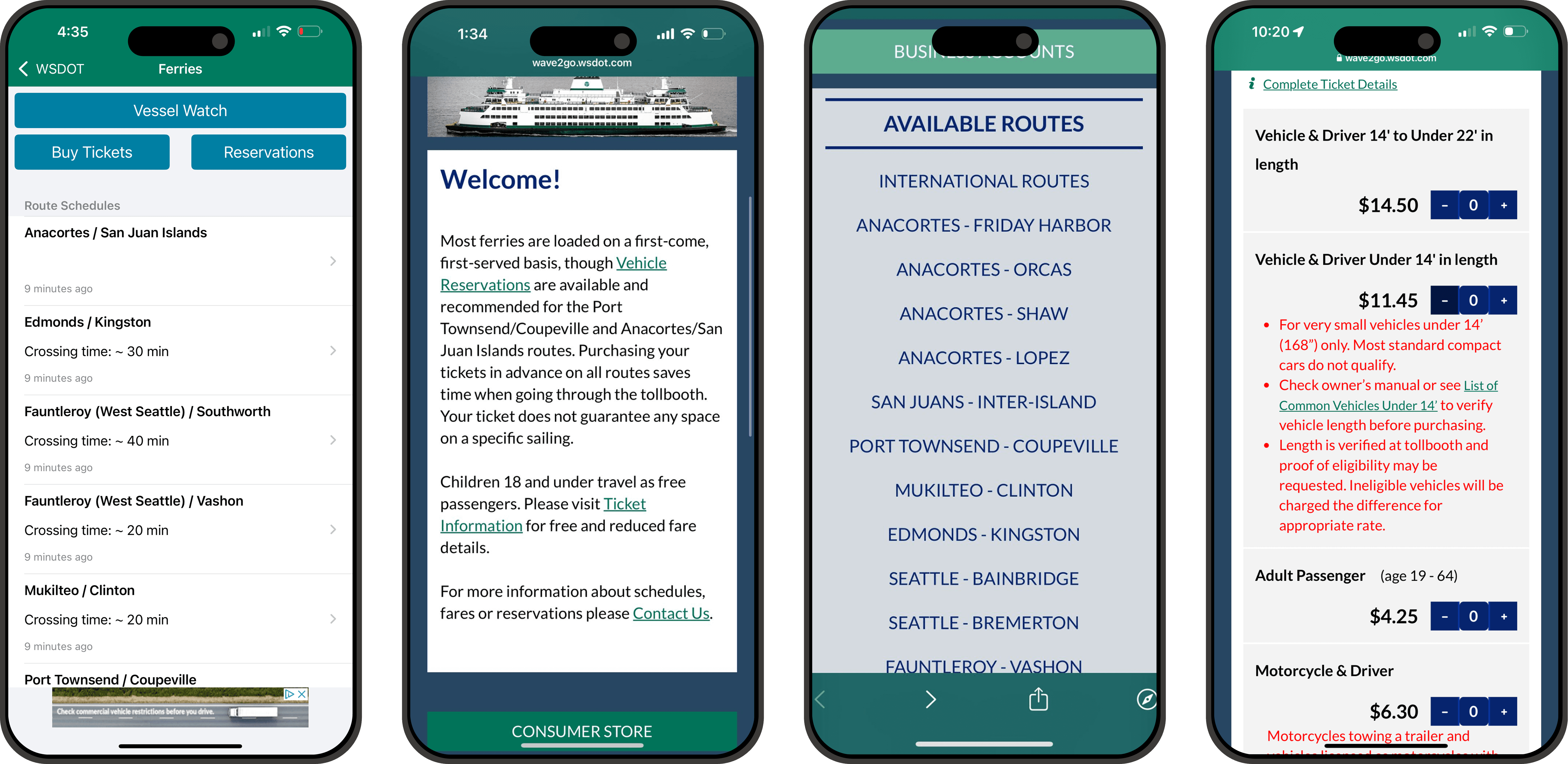
When riders tap Buy Tickets, the app redirects them to an external mobile site (wave2go.wsdot.com). The handoff is jarring, and the vehicle-size language, with red warnings that 'most standard compact cars do not qualify' for the smaller bucket, adds anxiety at the exact moment of purchase intent.
F · 02
HIGH SEVERITY
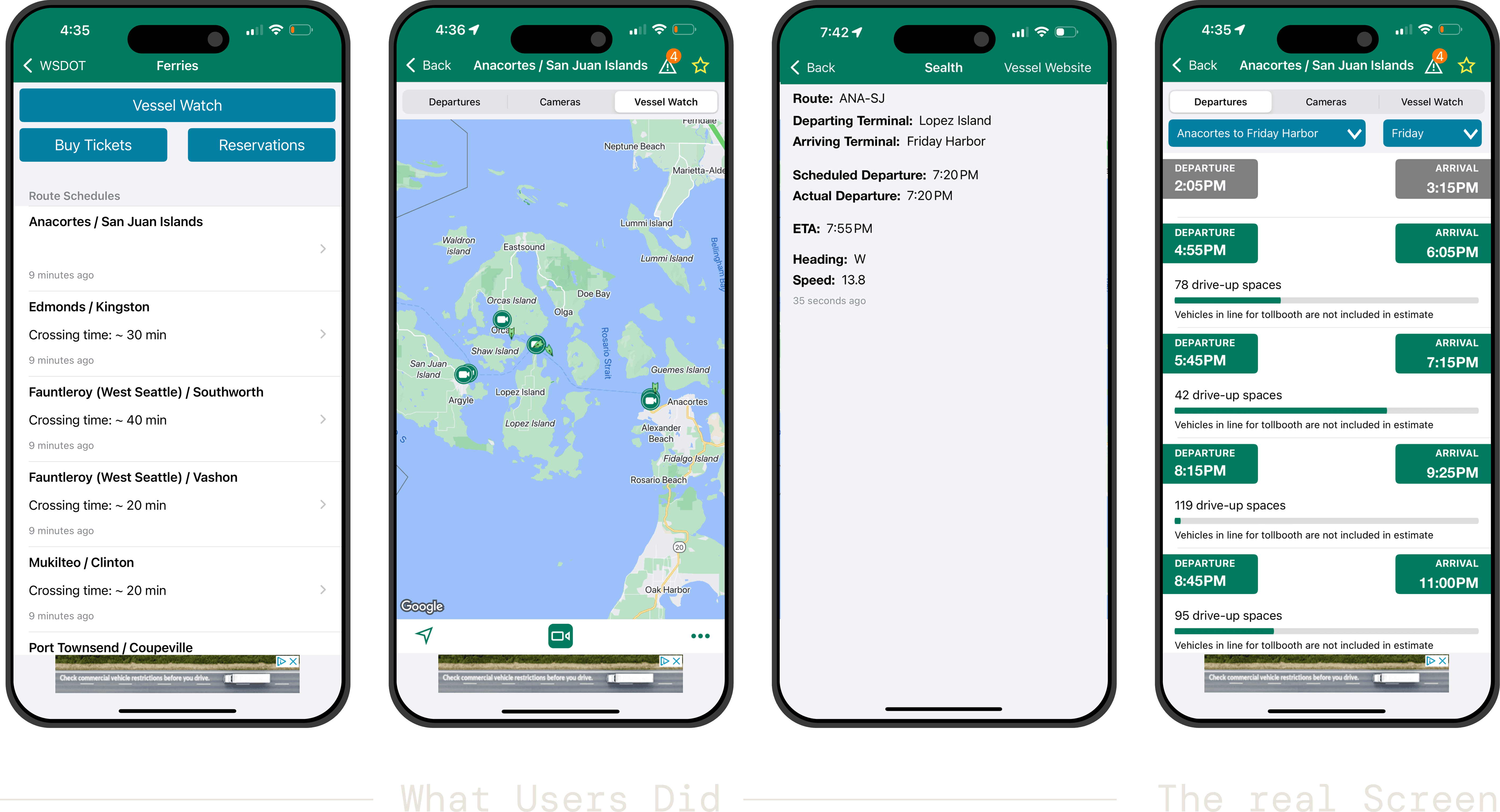
Vessel Watch became the first instinct — even for tasks it wasn't built for.
Riders went to Vessel Watch first when looking for ETAs, future schedules, and trip-planning info. The live map was valued, but the label and IA didn't communicate what each section is actually for, so users used the most visual one as a fallback.
EVIDENCE
Tasks 3.1 and 4.1 — multiple participants opened Vessel Watch first, then backtracked. 'Vessel Watch first' was the dominant initial-navigation cluster.
F · 03
HIGH SEVERITY
Inter-island routes were nearly impossible to find.
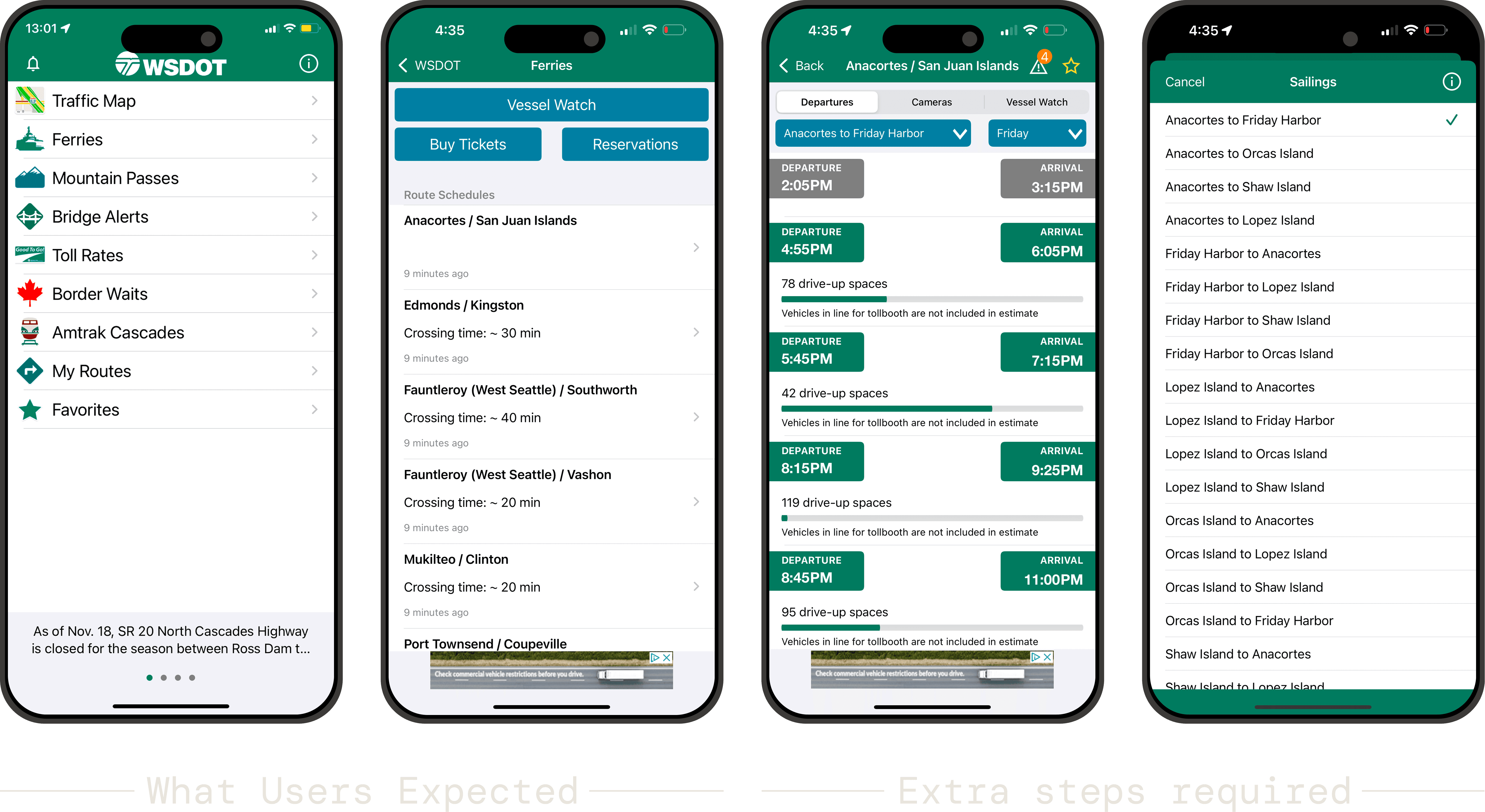
Friday Harbor → Shaw Island had the highest failure rate. Participants who succeeded leaned on their own knowledge of San Juan Islands geography rather than the app's structure. The route hierarchy didn't match how riders think about island-to-island travel.
EVIDENCE
Task 2 — failure and confusion clusters. P2: 'couldn't find Friday Harbor.' Common detour: into Vessel Watch and Reservations before backing out.
F · 04
MEDIUM SEVERITY
Riders expected information to flow across sections; the app keeps it siloed.
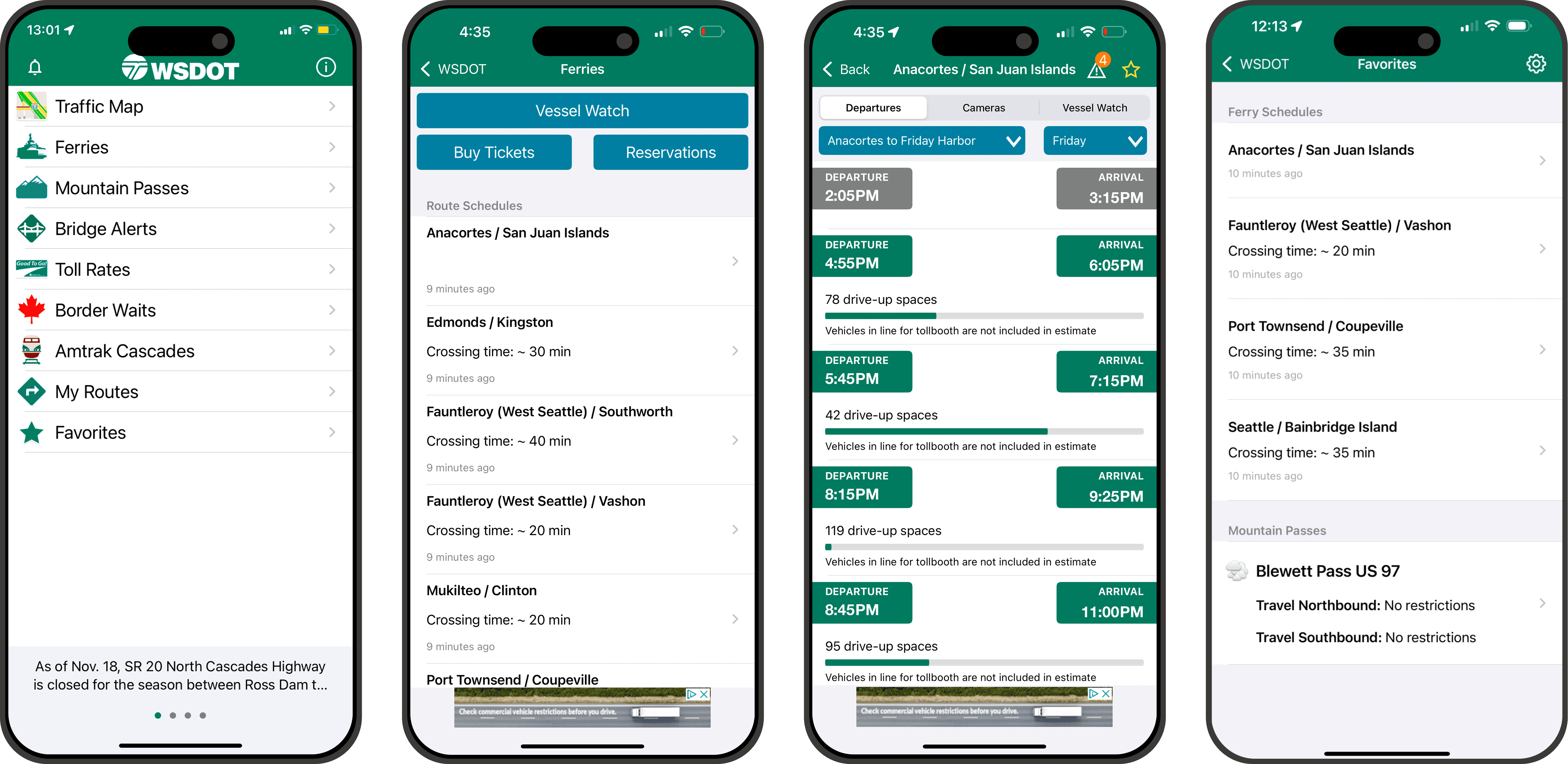
The app splits Departures, Vessel Watch, Buy Tickets, Reservations, and Cameras into discrete tabs. Riders expected them to talk to each other — a saved route should carry its alerts; a future-schedule lookup shouldn't start in Reservations. The separation forced unexpected detours.
EVIDENCE
Tasks 3.2 and 3.4 — 'went to Reservations expecting schedule.' Alerts cluster: expectation mismatch was the dominant theme, not findability.
04
Reflection
REFLECTION
The app is built around what WSDOT publishes — schedules, vessels, reservations, tickets — but riders arrive with one job: get on the right boat.The strongest finding wasn't any single bug. It was the consistent gap between the app's section structure and the route-and-moment mental model riders bring to it.
All friction points,
all recommendations and
every session note.
THE LONG VERSION
DESIGN QUESTION
How might we surface the right information at the right moment, so riders never need to leave the WSDOT app?
Of 9 task scenarios, the two highest-stakes, i.e. buying a ticket and finding an inter-island route failed most often. One sent riders to an external website mid-purchase.
KEY INSIGHT
Riders weren't failing because features were missing. They were failing because the app spoke the system's language, not theirs.
the summary
PROBLEM SCALE